
Insights
A pharmaceutical SOP changed: check the training and source version
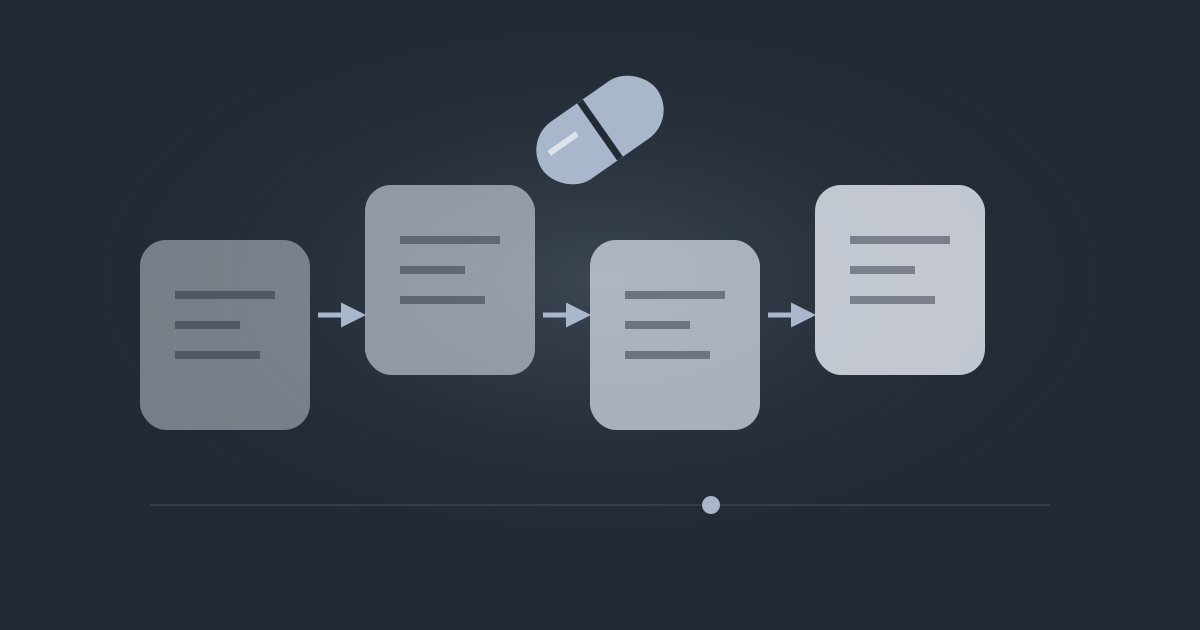
Finding the approved procedure, drafting training material and organising evidence are useful first applications of AI in a healthcare or pharmaceutical organisation. Each task can have a clear boundary, a known source and an identifiable owner. These controls become harder to establish when an application makes decisions affecting a patient or the quality of a medicinal product.
This guide covers administrative work, quality management and document control. It offers a way to prepare a project, rather than an assessment of any particular organisation. Legal requirements are linked to sources. The suggested pilot, sample sizes and allocation of responsibilities are author recommendations to be adapted to the actual process.
Choose a task with approved inputs
Look for repeated work on approved documents. Examples include locating the current instruction, checking a supplier document pack, identifying procedures due for review and drafting a short learning module after a document changes. Before selecting the task, measure how much time staff spend on it and why corrections occur.
An administrative assistant in a clinic can identify the instruction for handling a particular type of enquiry without reading a patient's treatment history. A quality team can compare a learning module with the current procedure version. Procurement can obtain a list of missing supplier documents. A pharmaceutical quality team can prepare references for a review while keeping assessment and approval with authorised personnel.
A useful answer identifies the source document, its version and the relevant section. Fluent wording does not establish accuracy. Where the approved source is missing, the assistant should explain the gap and refer the question to its owner. Inventing a plausible procedure number simply gives someone another problem to investigate.
Do not treat diagnosis, therapy selection, medical urgency assessment or batch release as extensions of this first project. Moving from administrative support to a medical or product quality decision changes the intended purpose and the consequences of an error. It also changes the assessment and validation needed. Calling the application an assistant does not remove that impact.
Establish which rules actually apply
The GDPR requires a defined purpose, an appropriate lawful basis and limits on personal data. Health information has additional conditions under Article 9. AI does not supply a lawful basis by itself. Processor arrangements, security measures and any required impact assessment must follow the real data flow; Articles 28, 32 and 35 are relevant to that analysis. [1]
NIS2 includes specified healthcare and pharmaceutical activities. However, the organisation's activity, size, exceptions, national implementation and competent authority decisions affect its scope. Check the position of the actual legal entity. A sector label is insufficient to conclude that every small practice has the same obligations as a large hospital. [2]
Under the AI Act, risk classification depends on the system's intended purpose and conditions of use. Certain decisions about access to healthcare and AI products or safety components can fall within high risk categories. An internal procedure search does not become high risk merely because a hospital uses it. Assess the function, the provider and deployer roles, and the current legal text. [3]
For human medicinal product manufacturing, also assess the system's GMP impact. EudraLex Annex 11 addresses computerised systems used in GMP activities. It covers a risk based approach to validation, suppliers, data integrity and continuity. A general chatbot contract does not settle these matters. [4] Pharmaceutical operations differ substantially; this guide addresses quality documentation rather than every requirement of every pharmaceutical activity.
Keep source material separate from proposals
Assign an owner to the knowledge collection. Record the identifier, version, effective date, approver and access restrictions for each procedure. Retain withdrawn versions under the applicable archive rules, but do not offer them as current instructions. Clearly mark material awaiting approval as a draft.
Distinguish between explaining a document and proposing a process change. The first answer refers to the approved source. The second is a suggestion for the process owner to assess. Without that distinction, a model's recommendation can start acting as an unofficial instruction before anyone has accepted responsibility for it.
Where two approved documents conflict, show both references and the uncertainty. The relevant owner should resolve the hierarchy and repair the documents. Automatically combining conflicting instructions can hide a real quality system defect. An absent appendix should likewise remain an identified gap; it should not be silently replaced with text from an unrelated website.
Align access with the work
The following allocation is a starting proposal. Agree it with the process owner, quality team, IT and the person responsible for data protection before use.
| Role | Required information | Permitted action | Decision retained by a person |
|---|---|---|---|
| Administrative worker | Approved instructions for their department | Search, ask questions, report a gap | Handle an exception in a case |
| Procedure owner | Document versions and proposed amendments | Review and approve content | Make the procedure effective |
| Training coordinator | Approved material and authorised staff list | Prepare and assign training | Confirm readiness to perform work |
| Technical administrator | Configuration, identifiers and technical logs | Manage access and stop the integration | Accept a technical change |
| Quality representative | Evidence and changes within the agreed scope | Review impact and results | Accept the quality process |
Use documents without patient data during the pilot whenever the task allows it. Removing a name does not necessarily anonymise a record. A rare condition, date and combination of details can still identify someone. Synthetic records help test behaviour without sending real treatment histories to a service.
Agree where information is processed, which subcontractors are involved, retention, model provider use and any international transfers. Check the actual contract and service settings. A broad claim about private AI does not resolve these questions. Include document copies, search indexes, attachments and logs in the assessment because each may contain restricted information.
Give integrations a small, enforceable scope
An API or MCP integration should expose specific operations, such as reading an approved instruction or creating a draft task. The technical account does not need the entire repository, patient records or production system. Restrict writes to selected fields and enforce permissions in the application, outside the language model.
Documents and messages are data, even when they contain apparent instructions. An attachment may attempt to make the assistant reveal information or invoke a tool. OWASP describes this as prompt injection. [5] Application permissions and constrained operations limit its possible consequences. A sentence telling the model to ignore outside instructions is not sufficient protection by itself.
Before a proposed write, show the user the recipient, proposed text, source and expected effect. Approval of a draft task should not trigger messages to patients or suppliers. Add messaging only as a separately assessed function, with its own permitted recipients and controls.
Turn procedure changes into controlled learning
A changed instruction affects the people carrying out the work. An assistant can highlight changes between versions, draft learning material and suggest assessment questions. The procedure owner should approve the material and answer key before release. Questions should test important process decisions rather than recall of paragraph numbers.
Zmianowo/CrewShift is being developed in early access to support training and tests based on customer documents, with human approval. Confirm the available functionality and scope before implementation. Course completion or a test score does not by itself constitute an official qualification or establish practical competence.
Some work also needs observation and approval by a supervisor. Record which procedure version the training covers, who completed it and whether a practical check was required. This makes the evidence more useful than a general statement that everyone has been trained. It also gives the next reviewer a way to distinguish obsolete learning records from current ones.
Collect evidence that answers specific questions
Evidence should show which sources produced an answer, who accepted it, whether that person had authority and which changes were made. A useful project pack includes the intended purpose, data inventory, access matrix, evaluation results, change record and stopping instructions. Adapt its detail and retention to the risk and applicable requirements.
Pulsar GRC is being developed in early access for work with customer documents, requirements, controls, risks, actions and evidence. It can support organisation of that work once the scope is confirmed. It does not take responsibility for deciding whether a requirement is met and does not guarantee an audit outcome.
Avoid logging complete content merely because it makes debugging convenient. Time, operation identifier, document version and status can often support an initial investigation. Where fuller records are necessary, establish the purpose, access and retention. Evidence should remain accessible to authorised reviewers throughout the period for which the organisation needs it.
Run one bounded pilot
As an initial organisational plan, consider ten working days and one procedure collection. This is an author recommendation, not a legal timetable or a delivery promise. Establish the goal, owner, data boundary and baseline first. Prepare questions with known correct answers and cases where refusing or reporting a gap is the right response.
Include an outdated instruction, a missing document, conflicting sources and an attempt to read another department's information. For learning material, check that questions and correct answers follow the procedure. If the application affects GMP work, its assessment and validation must address that impact; a small pilot does not remove the requirement. [4]
Test stopping the integration and returning to the existing manual process. Staff must know where to find the approved procedure when the assistant is unavailable. The person deciding whether to continue should receive the quality team's, IT team's and process owner's findings, including unresolved defects.
A fictional audit preparation example
The following example is fictional. A manufacturing site's quality team is compiling training evidence after a document handling instruction changes. Staff manually compare employee lists, the current version and completion records. The assistant is limited to approved procedures and a selected training register. It cannot access patient information or manufacturing parameters.
The result separates records into current confirmation, missing confirmation and an unclear entry. The coordinator investigates exceptions, assigns actions and approves the report. The system does not create confirmations that never existed. It does not convert an unclear entry into a positive result to make the report look complete.
Measure total work time, correction time, source accuracy and missed gaps. Compare tasks of similar difficulty. A proposed target such as reducing total effort by 20% is a hypothesis, not a Brillnet result. Stop the pilot if unauthorised access occurs or if an important missing record is wrongly classified as present.
Handle incidents and changes deliberately
If information is disclosed incorrectly, stop the affected integration, preserve the necessary evidence and activate the organisation's response process. Responsible staff assess the event and any reporting obligations. Applicable deadlines and recipients depend on the legal regime and incident classification. An incorrect answer is not automatically the same event as a personal data breach or a significant cybersecurity incident. [1][2]
Changes to the model, provider or document indexing can alter answers and access behaviour. Assess their effect before wider use. Agree an exit arrangement before starting: document and evidence export, technical account disconnection, handling of remaining copies and confirmation that the agreed actions were completed.
NIST's Generative AI Profile provides a voluntary framework for considering AI risks across a system's lifecycle. It can inform the review method, but using it does not certify a system or replace legal requirements. [6] The practical question remains whether the organisation can explain the application, recognise a failure and continue its work when the application stops.
Bring one process to the first discussion
Before launch, Brillnet agrees the tool scope, roles, data and exit arrangements. For an initial discussion, prepare the process name, a sample document without sensitive data, the current effort and the person authorised to approve the output. These details make it possible to assess feasibility and the required level of control.
Send your process description to Brillnet. For requirements and evidence, explore Pulsar GRC. For learning based on documents, explore CrewShift. The appropriate choice depends on the process, confirmed functionality and evidence of operation in your environment.
A synthetic SOP revision and training record
Use a fictional procedure called SOP-014, with an old version and a revised version. The example changes an administrative verification step and affects one defined team. It is a training exercise, not a validated pharmaceutical production instruction. Do not upload a real confidential dossier merely to reproduce the example.
Identify the changed passage and the people whose work is affected. Keep the old version and its history, then prepare training against the revised source. In CrewShift, request an AI draft only through the available manual process. A qualified person reviews the lesson and questions against the source and approves them under the required permissions before publication.
Assign the approved material to the relevant group and inspect completion records. Check the person, source version, result and completion date. A knowledge test demonstrates performance on its defined questions. It does not automatically demonstrate practical competence, authorize regulated work or replace an independently required qualification.
Read the report and identify any person still requiring the revised training. Keep an exception with its owner and next action. For actual GMP use, assess the computerized system for the intended purpose and applicable validation requirements; an article and generic SaaS trial do not provide a site-specific validation package or guarantee GMP or electronic-signature compliance.
CrewShift's 14-day trial covers up to 10 people and requires a card; a paid plan starts unless cancelled according to the current terms. The Polish product is named Zmianowo. Use the trial to inspect the source-to-report relationship in this synthetic case and decide what additional qualification your real process requires.

Sources
Verified on 2 October 2026. Legal sources require an applicability assessment for the particular organisation. The pilot and fictional scenario are author proposals.
- GDPR — Regulation (EU) 2016/679, Articles 5, 6, 9, 28 and 32–35. EUR-Lex; accessed: 2026-10-02.
- NIS2 — Directive (EU) 2022/2555, Articles 2, 21 and 23 and annexes. EUR-Lex; accessed: 2026-10-02.
- AI Act: intended purpose and risk classification and current consolidated Regulation (EU) 2024/1689. European Commission and EUR-Lex; accessed: 2026-10-02.
- EudraLex Volume 4 — Annex 11: Computerised Systems, revision 1 and current GMP document index. European Commission; accessed: 2026-10-02.
- NIST AI 600-1 — Generative Artificial Intelligence Profile. NIST; accessed: 2026-10-02. Voluntary guidance, not EU law. Sources checked: 2026-10-10.
- European Commission — EudraLex Volume 4 — GMP guidance, personnel and computerized systems.
- GDPR — Regulation (EU) 2016/679 — Personal-data principles, security, rights and processor relationships.
- EU AI Act — Regulation (EU) 2024/1689 — Applicable AI governance context.
- OWASP — LLM01 Prompt Injection — Untrusted document instructions and agent risks.
- CrewShift — source-to-training workflow and trial — Review, assignment, source versions and completions.
- Published product scope and trial terms — Published product scope and trial terms.
Review terms and start the 14-day trial

Audit an AI operation: authorization, result and verified state
Least privilege for AI agents in a multi-tenant SaaS
Food-production CAPA: from a finding to effectiveness review