
Insights
Automation for property management companies: cases, deadlines and evidence
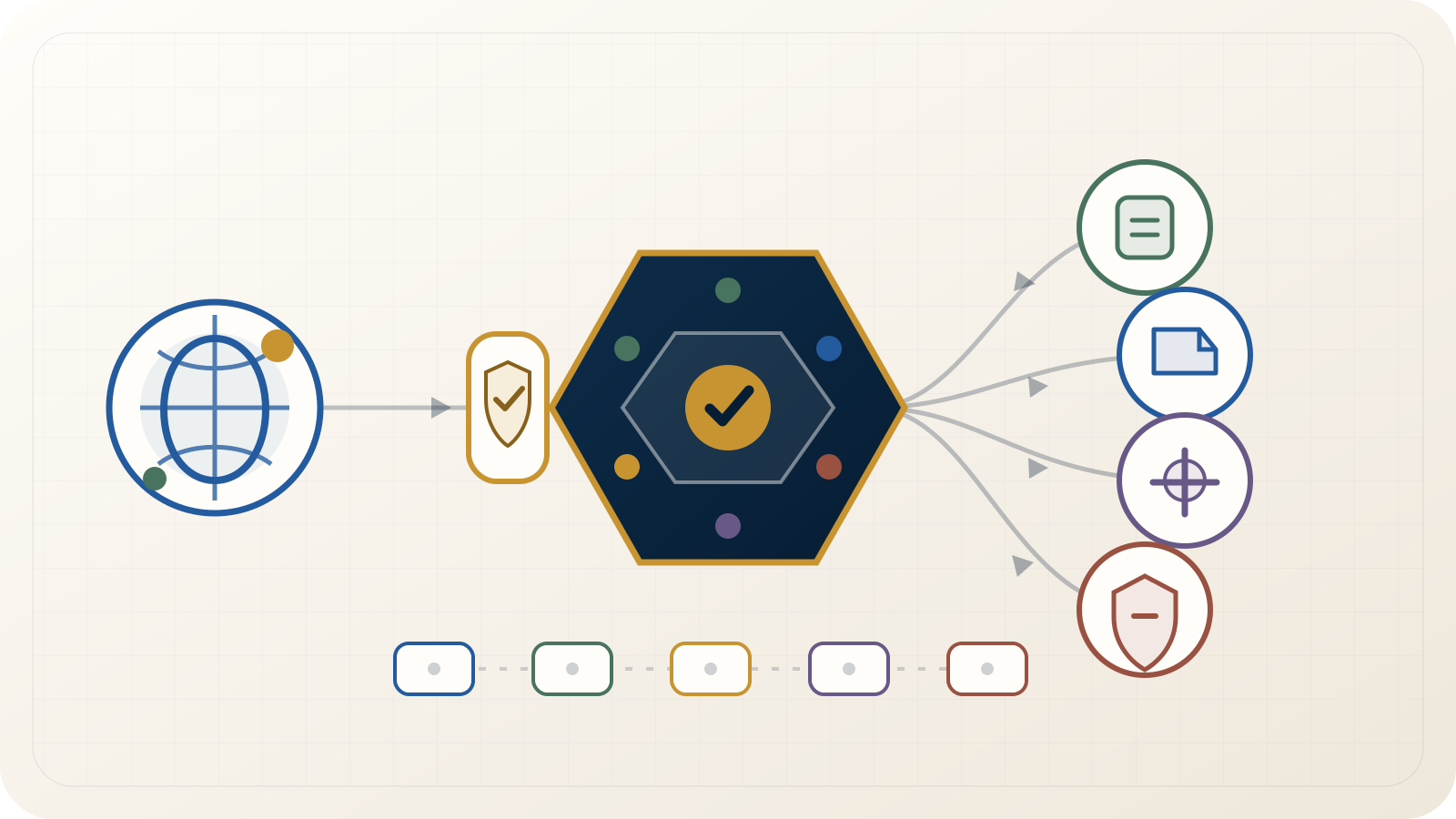
Start property management automation with a process that has a defined property, responsible person, next action and completion evidence. An ordinary maintenance request is a useful candidate. Asking an AI model to calculate charges from unorganised records is a much more difficult starting point.
The team should be able to reconstruct a decision before accelerating its execution. An owner asking about a repair, cost or balance needs a specific answer with a source. “The system calculated it” does not establish the reason or identify who had authority to approve it.
This guide is for companies managing a portfolio of residential properties or owners' associations. It proposes an operating process and pilot measures. The legal form, governance, accounting duties and authority to act depend on the jurisdiction and contract. A workflow for a Polish housing community must not be assumed to apply unchanged to another country, a cooperative or rented property.

Separate the property, case and decision
One inbox may serve many buildings, but their records need distinct contexts. Each case should identify the property, category, receipt date, responsible person and related documents. A message without a recognised property goes to clarification instead of being placed in an arbitrary folder.
The case describes a problem and its progress. A decision records an approved action, its basis and the authorised person. A document may supply evidence, but uploading it does not make the action approved. A quotation, invoice and acceptance record have different functions. Treating all of them as generic attachments makes cost explanations difficult.
For each property, record the applicable governance arrangement and authority to instruct work. The software role called “manager” is not sufficient evidence of legal authority. Determine who can approve the action and what supporting document is required before setting automation permissions.
Choose the first process by the cost of error
Over two weeks, count requests, the time spent sorting them and cases without an assigned person. Separate routine service communication from financial disputes, formal complaints and urgent situations. Not every message should wait in the same queue.
A first pilot can create a case identifier, suggest responsibility and prepare an acknowledgement. This removes transcription work. It does not determine who bears the repair cost, whether expenditure is approved or which contractor should receive an order.
Avoid beginning with actions that trigger payment, alter a balance or send a formal commitment. Establish the rules, source records and approval authority first. AI can help draft or locate information, while calculations and decisions need a verifiable basis. A plausible answer is not enough for a financial record.
Every request needs a next action
A proposed case record contains the property, location, category, description, contact needed for handling, receipt time, operational priority, assigned person and next action. Keep a response target separate from a repair target. An acknowledgement does not promise that the issue will be resolved by a particular date.
Choose statuses that explain the work: new, needs clarification, assigned, awaiting decision, in progress, awaiting acceptance and closed. For a waiting status, specify the person or information being awaited. A colleague covering the case can then see the blockage without reconstructing a conversation.
Require completion evidence appropriate to the request. This could be an acceptance record, approved note or confirmed response. A photograph may help, but does not always prove correct work. Identify who confirms completion instead of closing every case when a contractor says it is finished.
| Record | Required operating question | Useful check |
|---|---|---|
| Case | Who handles the next action? | An assigned person can see the deadline |
| Decision | Who approved it and why? | The supporting source is linked |
| Document | Which version applies? | The original remains available |
| Closure | What confirms completion? | Acceptance evidence matches the case |
Give urgent situations a separate route
Do not present a web form as an emergency channel unless the service is actually monitored accordingly. Explain its purpose, handling hours and the relevant emergency route under local instructions. A general AI assistant must not replace a suitable emergency contact.
Model-based urgency classification is a suggestion. It may miss an unusual description of flooding, installation damage or danger to people. Provide an independent escalation route and review unclassified requests. A difficult message needs human attention rather than disappearing behind a confidence score.
For an incident, preserve receipt time, instruction time, contact with the responsible party and intervention outcome. These records support an assessment of the response. They do not establish that every contractual or legal duty was fulfilled. Responsibility still depends on the circumstances and applicable obligations.
Documents must lead back to the source
For each document, identify the property, type, date, issuer, version and related cases. Preserve the original. If OCR is used, keep recognised text distinguishable from the document image. A misread amount, date or reference must not become an approved fact because it appears neatly in a table.
An assistant drafting an owner response should identify the source and version used. If no source is found, state what is missing. Inventing a likely explanation of a resolution or financial operation is especially harmful because the recipient may rely on it.
Use a simple distinction between working material, material awaiting review and approved material. The reviewer confirms its relationship to the original and permitted use. Every note does not need a complicated approval chain. Important decisions do need a clear boundary between a draft and their evidence.
Access should follow the task
GDPR applies to everyday records such as owner lists, correspondence, attachments and exports. Relevant requirements include limiting data, using appropriate safeguards and demonstrating accountability. Access to an entire portfolio should not be granted solely because it makes searching convenient. [1]
Define access for request handling, financial work, supervision and authorised property recipients. Check search results, attachments and exports as well as normal screens. Sending a correct file to the wrong association remains an error even when its filename contains the right address.
The Polish data protection authority published a housing community case involving failures around processor arrangements and protection of documents. Its practical relevance is the need to establish the actual roles and working arrangements. The case does not mean that every property management company in Europe has an identical legal role. [2]
For an AI service, identify the information sent, access, retention and subcontractors. A statement that a server is in Europe does not answer every processing question. Examine the contractual conditions and how data is handled when the relationship ends before approving a particular configuration.
Check the recipient before sending information
An automated acknowledgement can include the case identifier, what was received, the handling team and the next step. Do not add a repair date that has not been agreed. Do not include another owner's information to make the response more complete.
Before sharing financial or personal records, verify identity and authority using the agreed procedure. Where a response draws from several documents, check that their dates and periods match. The final text should contain information the company can point to in a source.
Operational communication with residents and marketing for the company's services have different purposes. An owner list does not automatically become a campaign list. Assess GDPR, ePrivacy and the applicable national rules separately before promotional sending. [1][3] Useful case handling does not require a sales offer in every message.
A fictional portfolio example
The following is a training scenario, not a Brillnet customer result. A company manages 12 owners' associations and receives 90 routine requests each week. Identifying the property and copying the details takes an average of three minutes, or 270 minutes overall. Fifteen cases lack an assigned handler.
The pilot covers three associations and ordinary shared-area defects. A form identifies the property, creates a case and routes it for assignment. The acknowledgement uses an approved template. AI classification, if used, remains a staff suggestion rather than a decision about liability or expenditure.
Compare two weeks before the change with two afterwards. Measure administration time, unassigned cases, incorrect property matches and repeated status enquiries. If sorting becomes faster while wrong assignments increase, pause expansion and fix identification. A larger model will not repair an unreliable property identifier.
Reconcile the records before migration
Choose a representative property without an active dispute dominating the pilot. Establish a cutoff date and data scope: units, owners, shares where relevant, agreed financial records, open cases and documents. A responsible person approves the source and completeness of each group.
Check identifiers, effective dates and relationships. A unit number may not be unique across several buildings. An ownership change requires the correct period and history. Do not repair a financial discrepancy by entering one unexplained balancing amount.
Before publishing imported records, compare record counts, a document sample and agreed financial totals. Correct an error once and repeat the affected check. The purpose is evidence that context and meaning survived migration, rather than an endless testing exercise.
Prepare a handover method for a future manager too. An export should be understandable without the person who created it. Include its date, scope, field descriptions and open cases. Verify that the package can be read before treating the handover as complete.
Make cover and staff changes explicit
At the end of a shift, record only what changes the next action: a pending decision, promised contact, missing document or approaching deadline. The covering colleague should know what to do after opening the case and which source supports the last agreement.
Define cover separately from data access. Taking over one task does not require the whole property portfolio. Also name a substitute approver where necessary. Otherwise the software may send accurate reminders to someone who is away and cannot act.
When an employee leaves, reassign open cases, remove unnecessary permissions and review active notifications. When the management company changes, record what was transferred, what remains missing and which issues are disputed. This avoids a prolonged attempt to reconstruct the attachment list from old messages.
Measure service quality and operating cost
Review time to the first substantive response, cases with an assigned handler, overdue actions and blockage reasons each week. Separate closed cases from reopened ones. Faster closure without acceptance may improve a chart while increasing complaints.
For financial operations, measure whether their basis can be reconstructed and how often corrections are needed. For documents, measure time to find the right version. Include configuration, exception handling and integration maintenance in the cost. Generated answer counts do not replace these measures.
After a month, extend the process only if it works during staff cover. A colleague should see the status, blockage, source and next action. If they need a private conversation with the previous handler, part of the process remains outside the records.
Where WM Administrator fits
WM Administrator is Brillnet's Polish product for property management companies and housing communities. Its public description covers units and owners, charges, funds, documents, resolutions, cases, deadlines, roles and data export. Selected accounting, OCR, voting and purchasing capabilities are separate modules with their own configuration. [4]
Check the current scope before choosing a process. This guide does not imply support for every country's accounting, association governance or tax requirements. Software helps retain records and run an agreed workflow; it does not replace an authorised legal, tax or financial decision maker.
For a discussion with Brillnet, prepare an anonymised case, the number and types of properties, your data sources and the task that takes most historical reconstruction. Contact Brillnet. A useful implementation scope identifies the record created, the person who checks it and the evidence retained.
Sources
Sources support the identified legal facts and public product scope. Workflows, measures and the fictional example are Brillnet's operating recommendations. Verification date: 2026-10-02.
- European Parliament and Council, GDPR, particularly Articles 5, 6, 28 and 32: https://eur-lex.europa.eu/legal-content/EN/TXT/?uri=CELEX:02016R0679-20160504 — accessed 2026-10-02.
- UODO, housing community enforcement case, 22 March 2023; a Polish case, not a universal allocation of property management roles: https://www.uodo.gov.pl/pl/138/2656 — accessed 2026-10-02.
- European Parliament and Council, Directive 2002/58/EC, Article 13; assess applicable national implementation: https://eur-lex.europa.eu/legal-content/EN/TXT/?uri=CELEX:02002L0058-20091219 — accessed 2026-10-02.
- WM Administrator, public description of core scope, modules and limitations, in Polish: https://wm-admin.pl/ — accessed 2026-10-02.